
On Edge: Why Biofeedback Is the Most Important Leadership Tool You Haven't Met Yet
How biofeedback turns stress into data you can manage, and why it is a first-rate tool for leadership development
How biofeedback turns stress into data you can manage, and why it is a first-rate tool for leadership development
Picture an ordinary morning as a manager. You have just wrapped up one meeting, and in two minutes another one begins, where you need to resolve a conflict between two managers on your team. Meanwhile your phone buzzes with news of an unexpected project delay, and your inbox keeps filling up. On the outside, you look composed and in control. Business as usual. But beneath the surface? Your heart rate picks up slightly, your breathing turns shallow, the muscles in your neck and jaw tighten. Without noticing, your nervous system has switched into defense mode and is sending your body a single command: danger.
Most of the time, you are not even aware of this automatic mechanism running in the background. The cost of that hidden tension is significant: your energy reserves drain fast, your capacity to listen and empathize drops, and your responses become reactive and survival-driven instead of deliberate and strategic, exactly when you need your focus most.
Management means constant load, rapid switching between topics, leading people and holding tension in the middle of uncertainty. Faced with this reality, most of us try to solve the overload with our heads: another spreadsheet, another status meeting, another time-management app. The problem is that the real key to focus, clear decision-making and steady leadership presence lies in the body.
This is exactly where biofeedback comes in.
If we had to explain biofeedback in one sentence, we would say it is the dashboard of your nervous system.
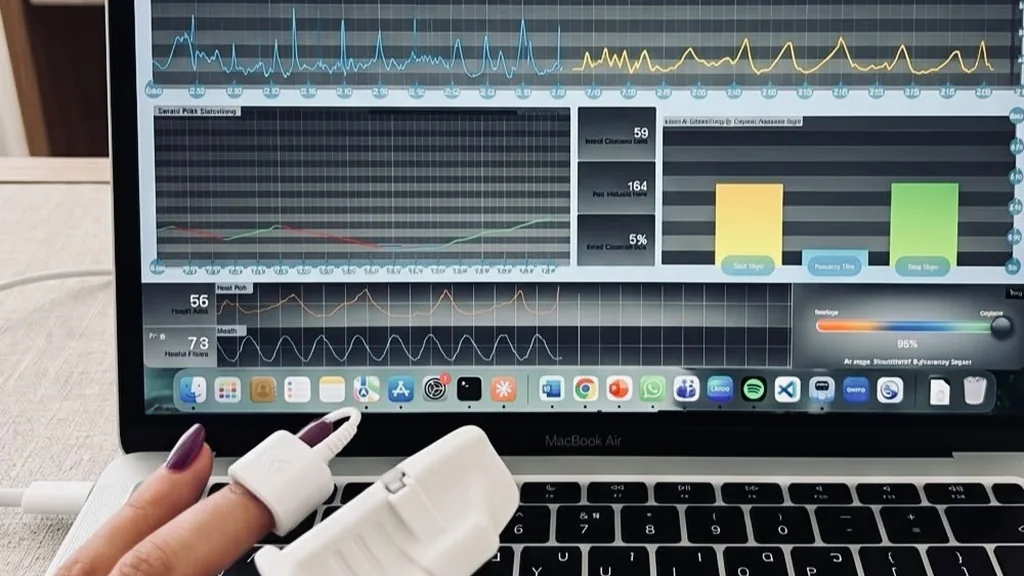
Managers are used to working with data: we measure goals, output and return on investment. But what about the metrics of the most important and influential resource in the organization, namely you? Using simple sensors that read signals such as heart rate, skin conductance and breathing rate, biofeedback technology translates what is happening inside your body in real time and displays it on a screen.
Suddenly, stress becomes a clear graph you can see. Once the data is right in front of us, we can start managing it. Through focused breathing and attention techniques, the instant feedback on the screen teaches us how to create active physiological regulation. We learn, in practice, how to lower our heart rate and calm the system through thought and action.
The ability to manage our physiology completely changes the way we manage people. Here is how it shows up:
When the body is under stress, the part of the brain responsible for survival takes command, and the part responsible for logical thinking, creativity and strategic perspective weakens. Leadership requires vision and a wide view, but a manager who is not physiologically regulated will tend to decide from defensiveness or a false sense of urgency. Biofeedback training helps you recognize the moment of overwhelm and cool the system down, so you decide from clarity rather than anxiety.
There is an unwritten rule in management: the leader's nervous system calibrates the nervous system of the entire team. A tense, on-edge manager creates a team that is strained, worn out and full of conflict. A manager who knows how to self-regulate projects stability and confidence that ripple through the whole organization. Real leadership starts with the manager's ability to hold their inner anchor, even in the middle of organizational turbulence or systemic change.
The price of leading in a high-pressure environment without regulation tools is a slow collapse. Sustainable leadership requires smart energy management. Biofeedback does not remove the demands of the business world, but it completely changes how our body responds to them. It enables faster recovery after intense days and prevents chronic stress from building up, so managers can keep going and keep leading over time.
Our bodies were designed to respond to physical threats, not to a critical email from a client late in the evening or a sudden budget cut. Our physiological response to these modern threats is usually automatic and overwhelming. Practicing with biofeedback puts you back in the driver's seat. It trains you to move from reactivity to a conscious response, which may be the most important leadership skill of all: the ability to choose your response to a situation instead of letting it run you.
All of these reasons lead to one clear conclusion: biofeedback is not just another technical tool or a stress-relief method. It is a first-rate tool for leadership development.
Organizations that want to stay competitive, innovative and relevant cannot rely on classic management training alone. They must equip their managers with tools to manage their own energy and physiology. Biofeedback is advanced training for building resilience and focus, and above all, leading through regulation, which starts deep within and resonates outward to the team, the organization and the bottom line.
Tell us about the challenges facing your management layer, and we'll explore together how biofeedback could fit into your leadership development.
Talk to us